
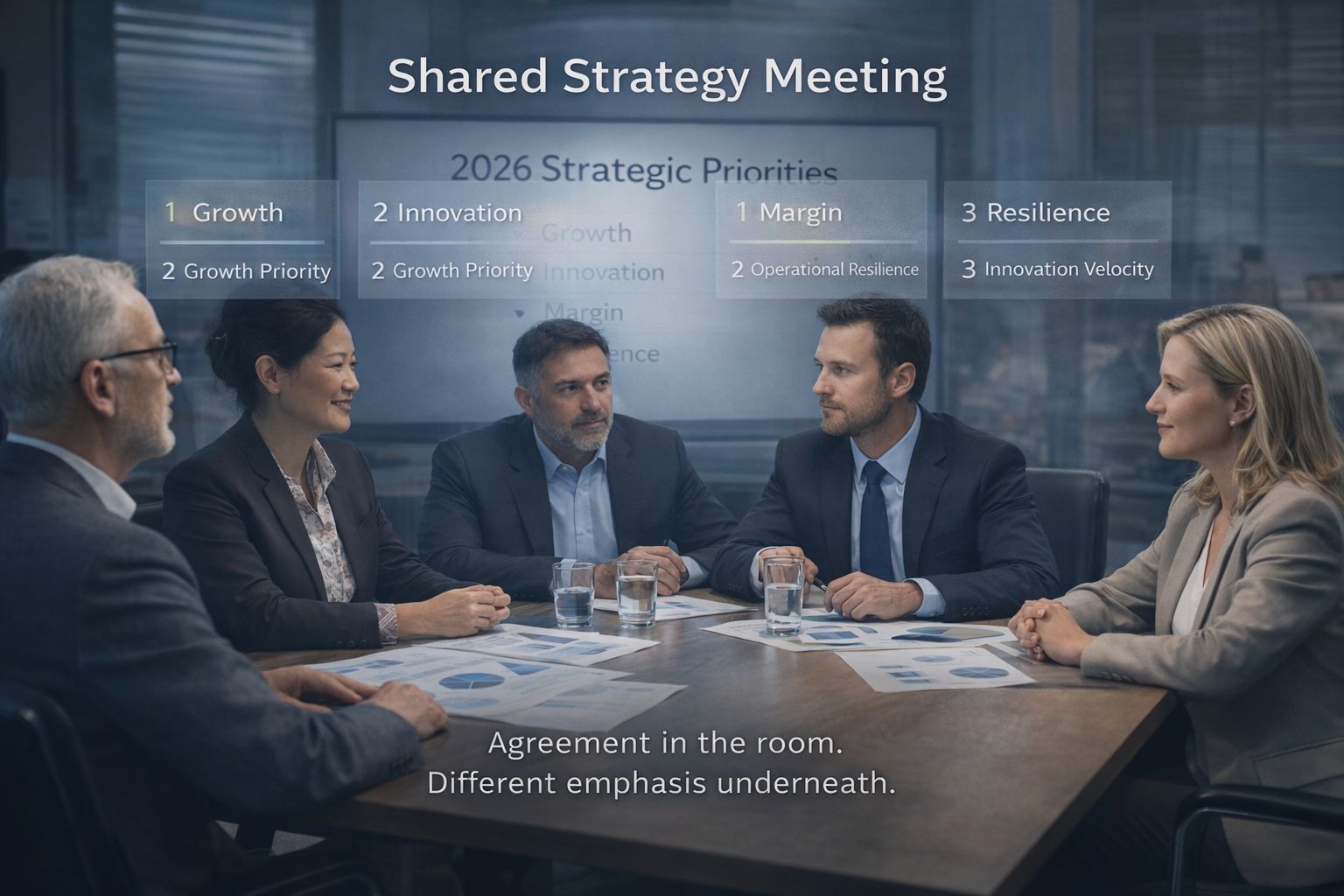
Strategic Alignment Is Not Agreement
Most executive teams believe they are aligned.
They leave meetings confident. The strategy slide is approved. Heads nod. Consensus appears clear.
Execution is usually where they discover they are not aligned.
A recent Harvard Business Review article, What Leaders Get Wrong About Strategic Alignment, highlights a persistent leadership blind spot: agreement in conversation does not equal shared interpretation. https://hbr.org/2026/01/what-leaders-get-wrong-about-strategic-alignment?
The illusion of alignment
Alignment is often confused with harmony.
If no one objects, leaders assume clarity exists. If the presentation is endorsed, they assume priorities are understood the same way across functions.
But real strategic alignment requires more than shared language. It requires shared interpretation of:
- Which priority comes first
- Which trade-offs are acceptable
- What risks are most urgent
- What success actually means
Leaders may all say “growth matters.” But some may mean revenue expansion. Others mean margin improvement. Others mean innovation velocity. Others mean operational resilience.
The word is shared. The interpretation is not.
Where misalignment shows up?
Strategic misalignment rarely reveals itself in the meeting room. It surfaces later:
- Competing KPIs
- Conflicting resource allocations
- Slowed decision-making
- Repeated re-litigation of priorities
- Cross-functional friction
Each executive believes they are executing the agreed strategy. The problem is that they are executing different versions of it.
The article emphasizes that alignment failure is rarely caused by bad strategy. It is caused by differing assumptions underneath shared terminology.
Agreement feels like alignment. It often is not.
Why this matters for execution
Execution depends on coordinated decision-making. When leaders interpret strategy differently, they pull in slightly different directions. Individually, the differences appear small. Collectively, they produce friction.
Over time, this friction compounds into:
- Delays
- Rework
- Budget overruns
- Confused teams
- Strategy drift
The cost of misalignment is rarely visible at the start. It accumulates quietly.
Constructive debate vs. invisible divergence
Healthy disagreement during strategy formulation is valuable. It sharpens thinking and surfaces risks.
The issue described in the HBR article is not open conflict. It is invisible divergence.
Leaders believe alignment has been achieved. In reality, underlying assumptions were never fully surfaced.
The meeting feels unified. Execution reveals fragmentation.
The core insight
Strategic alignment is not about whether leaders agree in the room. It is about whether they interpret priorities the same way when making independent decisions.
If those interpretations differ, alignment is assumed, not real.
And assumed alignment is a structural execution risk.
The most important shift for leaders is this:
Stop asking, “Do we agree?”
Start asking, “Are we interpreting this the same way?”
That distinction determines whether strategy survives contact with execution